

Battery Market to Reach USD 854.90 Billion by 2035, Driven by EV Revolution and Energy Storage Demand
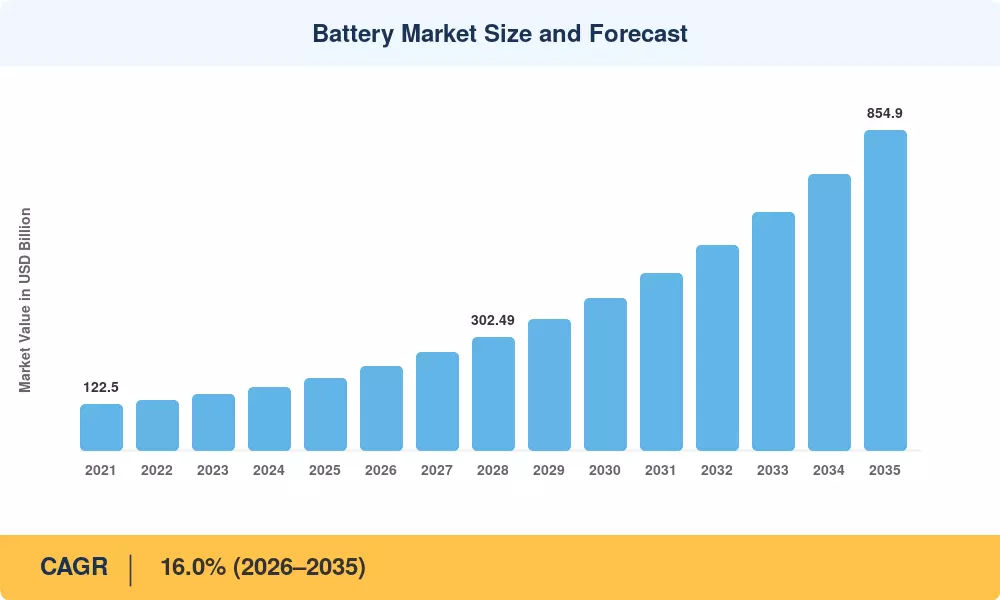
Battery Market Size
Solid-state chemistries are registering the fastest CAGR at 29.2% as pilot manufacturing transitions to volume production.
North America is expanding at a 17.8% CAGR, the second-fastest among regions, fueled by IRA incentives and domestic reshoring.”
NEW YORK, NY, UNITED STATES, August 31, 2026 /EINPresswire.com/ -- The Battery Market reached an estimated USD 192.70 Billion in 2025 and is projected to grow from USD 224.80 Billion in 2026 to USD 854.90 Billion by 2035, registering a CAGR of 16.0% during the forecast period. This extraordinary growth is anchored in two structural forces: the accelerating global transition to electric vehicles and the rapid deployment of grid-scale energy storage systems. Global lithium-ion battery deployment in 2025 was six times as high as in 2020, with electric vehicles accounting for more than 70% of total deployment, followed by battery energy storage at over 15% . As applications diversify and costs continue to fall, batteries are evolving into a foundational component of modern economies.— Snehal Singh
Market Overview
Batteries are electrochemical devices that store chemical energy and convert it to electrical energy on demand, serving as the cornerstone of modern energy systems. The market encompasses various technologies including lithium-ion, lead-acid, nickel-based, solid-state, and flow batteries, serving applications across electric vehicles, consumer electronics, industrial equipment, and grid-scale energy storage. The global battery market is growing rapidly, driven by falling costs, expanding applications, and the strategic importance of batteries across autos, power systems, and digital infrastructure including data centres and artificial intelligence .
The market is experiencing unprecedented growth driven by several key factors. Rising demand for electric vehicles (EVs) represents the most powerful catalyst, with global EV sales reaching a new record and accounting for one-in-four cars sold globally . Major automotive brands are forming long-term partnerships and investments in battery manufacturing to meet escalating need. Falling battery prices, supported by advances in manufacturing, improvements in chemistries, and intensifying global competition, have been instrumental to this expansion. In 2025, average battery prices declined by 8%, with battery energy storage systems seeing the sharpest price declines .
Industry trends indicate a significant shift toward sustainability and technology diversification. LFP batteries now account for over half of EV batteries and over 90% of battery energy storage systems globally, benefiting from structurally lower material costs and superior thermal stability . The automotive segment accounted for approximately 45.25% of the market in 2025 . Battery recycling initiatives, second-life applications, and digital battery passports are moving from compliance topics to commercial differentiators as larger EV fleets age .
Technological developments are reshaping the market landscape. Solid-state batteries are receiving aggressive investment for next-generation architectures designed to eliminate flammable liquid electrolytes . Sodium-ion batteries are inching closer to mass production for certain mobility and energy storage applications . Artificial intelligence integration in battery management systems is optimizing performance and safety . Advanced manufacturing technologies including dry coating innovation, automation, and AI-enabled quality control are setting new productivity and quality standards .
Policy and regulatory influence continues to shape market dynamics. Governments are implementing incentives, local content mandates, and mineral strategies to reduce reliance on concentrated supply chains . The U.S. has accelerated domestic battery manufacturing through federal and state-level clean energy policies . India's National Programme on Advanced Chemistry Cell (ACC) Battery Storage supports domestic manufacturing capacity and supply chain localization . The EU's regulatory framework emphasizes carbon footprint reporting, battery passports, and extended producer responsibility .
The Asia Pacific region dominates the battery market with the largest regional share of approximately 47-63%, led by China's enormous battery-cell manufacturing capacity, integrated supply chains, and strong domestic demand . North America is the fastest-growing region, fueled by large-scale investment in domestic battery production, increasing deployment of grid-scale energy storage, and rising demand across electric mobility and clean-energy infrastructure . Europe remains a significant market, driven by automotive engineering strength, industrial manufacturing, and energy transition agendas .
Get Free Sample Report for Detailed Market Insights:
https://www.marketresearchfuture.com/sample_request/2930
Market Segmentation
By Technology
Lithium-Ion: Dominates the market, with LFP and NMC as the most deployed chemistries; LFP batteries are more than 40% cheaper than NMC alternatives
Lead-Acid: Persists in starting-lighting-ignition, telecom backup, and motive power applications where cost per cycle and recyclability are prioritized
Solid-State: Expected to grow at a CAGR of 11.25%, fueled by investments in ultra-safe, high-capacity storage solutions
Nickel-Metal Hydride: Now holds a smaller share after the shift to plug-in architectures, though still specified for markets facing lithium constraints
Flow Batteries: Pursuing six- to twelve-hour niches where energy-to-power ratios favor decoupled scaling
Sodium-Ion: Introduced commercially in 2024, targeting entry-level EVs and long-duration storage
By Application
Electric Vehicles: Dominant driver of demand, accounting for more than 70% of total lithium-ion battery deployment
Energy Storage Systems: Growing rapidly with global installations increasing more than 20-fold in storage capacity over the past five years
Consumer Electronics: Has fallen from nearly half of global demand in 2015 to below 5% by 2025
Industrial: Includes automated material handling, heavy-duty robotic systems, and backup power for telecommunications and data centers
Aerospace & Defense: Serves unmanned defense systems, avionics, and humanoid robots
By Type
Secondary (Rechargeable) Batteries: Accounted for a commanding 90.6% of 2025 revenue, forecast to grow at 18.5% CAGR through 2031
Primary Batteries: Retained a 9.4% share, serving sensors, medical implants, and emergency equipment
You can buy this market report at:
https://www.marketresearchfuture.com/checkout?currency=one_user-USD&report_id=2930
Regional Analysis
Asia-Pacific
Asia-Pacific accounts for the largest regional share of the battery market, driven by extensive manufacturing capacity and rapid electrification. China leads with enormous battery-cell and component manufacturing capacity, integrated supply chains for cathode materials, anodes, electrolytes, and strong domestic demand . Japan contributes advanced battery research, safety engineering, and solid-state battery development . India is rapidly building its battery ecosystem through electric two-wheelers, grid storage, and domestic manufacturing incentives . South Korea remains a major center for high-performance cell development, cathode technology, and export-oriented production . ASEAN is becoming an increasingly important hub as member economies expand EV assembly and renewable energy integration .
North America
North America is the fastest-growing region with a CAGR of approximately 12.68% . The United States is accelerating domestic battery manufacturing, grid storage deployment, and critical mineral processing through federal and state-level policies . Canada provides mineral resources including lithium, nickel, cobalt, and graphite, along with hydropower-backed processing potential and automotive supply-chain integration . Mexico is gaining relevance through automotive manufacturing proximity, nearshoring, and its role in North American electrification supply chains .
Europe
Germany remains central to European battery demand due to its automotive engineering base, industrial manufacturing strength, and energy transition agenda . The United Kingdom is focused on battery innovation, recycling, and grid flexibility . France is investing in low-carbon manufacturing and recycling capacity . Nordic countries support battery demand through renewable energy integration and industrial decarbonization initiatives . The localization of battery supply chains is creating additional manufacturing and capacity-expansion opportunities across the region .
Rest of the World
South America, led by Brazil, is supporting battery demand through renewable energy growth, industrial electrification, and emerging energy storage needs . The GCC is adopting batteries to support solar power deployment, grid flexibility, and diversification away from hydrocarbon-dependent energy systems . Australia is critical for lithium and other battery minerals and is working to move higher in the value chain through refining, processing, and storage deployment .
Competitive Landscape / Key Players
The battery market is growing rapidly, driven by evolving consumer preferences, technological advancements, and increasing end-user demand. Key players are focusing on R&D for next-generation chemistries, vertical integration to control costs, and forging long-term agreements with raw material suppliers .
Contemporary Amperex Technology Co., Ltd. (CATL) (~30-35% global EV battery market share): Leader in LFP and NMC battery production; unveiled Shenxing PLUS, the world's first LFP battery achieving over 1,000 km range with 4C superfast charging .
BYD Company: Integrated EV and battery manufacturer; Blade Battery technology for improved safety and performance .
LG Energy Solution: Major supplier of lithium-ion batteries for automotive and energy storage applications .
Panasonic Corporation: Long-term Tesla partner and leading battery cell manufacturer .
Samsung SDI: High-performance cell development, cathode technology, and export-oriented production .
Other notable players include SK Innovation, A123 Systems, Toshiba Corporation, Envision AESC, Northvolt, EVE Energy, CALB Technology, and Solid Power. Recent developments include ESS Tech launching the Bridge™ modular sodium-ion battery energy storage system , and Eni and Seri Industrial launching FAENIX, a joint venture focused on developing LFP stationary battery energy storage systems across Europe .
Latest Industry News & Developments
ESS Tech (July 2026): Launched the Bridge™ modular sodium-ion battery energy storage system featuring 1.2 MWh building blocks, scalable to 4.8 MWh in a standard 20-foot container .
CATL (April 2024): Unveiled Shenxing PLUS, the world's first LFP battery achieving over 1,000 kilometers range with 4C superfast charging .
Sunotec and GEN-I (2025): Commissioned a 50 MW / 126 MWh battery energy storage system in Byala Slatina, Bulgaria, to improve grid stability and support Southeast Europe's energy transition .
U.S. Federal Clean Energy Manufacturing Incentives (2026): Implementation of incentives encouraging localized production of cells, modules, and battery materials .
Market Challenges & Opportunities
Key Restraints
Critical-mineral supply bottlenecks pose the most significant challenge, with lithium demand set to quintuple by 2040 yet new mines facing seven- to ten-year lead times . China refines 60% of the world's lithium and 80% of cathode materials, concentrating supply chain risk . Cobalt supply is constrained as the Democratic Republic of Congo supplies 70% of mined volumes . Supply chain vulnerabilities and limited availability of essential raw materials create geopolitical risks and price fluctuations . Environmental concerns around mining and disposal processes raise sustainability issues and regulatory pressures . The recycling infrastructure for lithium-ion batteries remains underdeveloped, leading to inefficiencies in resource recovery .
Emerging Opportunities
Utility-scale storage procurement offers one of the clearest investment pathways as power systems need flexible capacity with rising renewable generation . Localized battery materials and recycling hubs create opportunities for companies seeking supply security and regulatory compliance . Closed-loop battery value chains integrating recycling, second-life applications, and digital battery passports are becoming commercial differentiators . Chemistry diversification beyond conventional lithium-ion, including sodium-ion and flow batteries, mitigates risk from rare metals and allows customers to choose fit-for-purpose technologies . Data centers and AI infrastructure represent growing demand for battery backup power .
Future Potential
Artificial intelligence in battery management systems will optimize performance and safety . Advanced manufacturing and digitalization will set new productivity and quality standards . The circular economy approach to battery value chains will reduce reliance on virgin materials . Geopolitical developments will drive supply chain localization and diversified sourcing . The battery industry is entering a decisive phase defined by electrification, energy security, technology diversification, and circular value chains, with growth in electric vehicles, renewable energy storage, and digital infrastructure making batteries a foundational technology for both decarbonization and economic competitiveness .
To explore more market insights, visit us at:
https://www.marketresearchfuture.com/reports/battery-market-2930
Final Market Summary
The global Battery Market is positioned for extraordinary growth, with projections indicating expansion from USD 224.80 billion in 2026 to USD 854.90 billion by 2035, registering a 16.0% CAGR. Market dynamics are driven by the convergence of the electric vehicle revolution, grid-scale energy storage deployment, and technological innovation in battery chemistries. The shift from conventional lithium-ion to diversified chemistries including LFP, solid-state, and sodium-ion is transforming the market landscape.
Asia-Pacific dominates the market with the largest regional share, led by China's manufacturing scale and integrated supply chains, while North America delivers the fastest regional growth fueled by domestic manufacturing investment and policy incentives. Europe remains a significant market driven by automotive engineering strength and energy transition agendas. While challenges including critical-mineral supply bottlenecks and environmental concerns persist, the long-term industry outlook remains exceptionally robust, supported by the essential role of batteries in enabling the electrification of transport, renewable energy integration, and digital infrastructure. The decade ahead promises a structural expansion cycle unlike anything the energy sector has experienced, with batteries becoming a cornerstone of modern economies and a foundational technology for decarbonization and economic competitiveness.
More Related Reoprts:
battery energy storage systems market: https://www.marketresearchfuture.com/reports/battery-energy-storage-systems-market-20711
solid state transformer market: https://www.marketresearchfuture.com/reports/solid-state-transformer-market-5857
battery recycling market: https://www.marketresearchfuture.com/reports/battery-recycling-market-10020
fuel cell market: https://www.marketresearchfuture.com/reports/fuel-cell-market-10961
energy storage system market: https://www.marketresearchfuture.com/reports/energy-storage-system-market-18829
biodiesel market: https://www.marketresearchfuture.com/reports/biodiesel-market-1521
germany smart meters market: https://www.marketresearchfuture.com/reports/germany-smart-meters-market-54792
india power transformer market: https://www.marketresearchfuture.com/reports/india-power-transformer-market-48591
medium voltage cables market: https://www.marketresearchfuture.com/reports/medium-voltage-cables-market-4584
charcoal briquette market: https://www.marketresearchfuture.com/reports/charcoal-briquette-market-22274
Market Research Future
Market Research Future
+ +1 855-661-4441
email us here
Legal Disclaimer:
EIN Presswire provides this news content "as is" without warranty of any kind. We do not accept any responsibility or liability for the accuracy, content, images, videos, licenses, completeness, legality, or reliability of the information contained in this article. If you have any complaints or copyright issues related to this article, kindly contact the author above.
